In the history of medicine, the terms “pathy” and “therapy” have developed along different linguistic and conceptual lines, even though both relate to health and disease. “Pathy” (from the Greek pathos, meaning suffering or disease) is usually used today as a suffix in the names of complete medical systems or schools of thought: allopathy, homeopathy, naturopathy, osteopathy, etc. These “pathies” tend to represent distinct philosophies of disease causation and treatment, often with their own diagnostic frameworks, materia medica, and methods. “Therapy” (from the Greek therapeia, meaning treatment, service, or healing), on the other hand, refers more broadly to specific methods or processes used to treat illness or improve health, such as chemotherapy, physiotherapy, psychotherapy, or aromatherapy.
Historically, medical “pathies” often emerged as reactions or alternatives to the dominant medical paradigm of their time. For example, in the 18th–19th centuries, Samuel Hahnemann founded homeopathy as a response to the aggressive bloodletting and purging of conventional (allopathic) medicine. Naturopathy arose in the late 19th and early 20th centuries emphasizing “the healing power of nature” and lifestyle modification over drugs and surgery. These systems (pathies) bundled together a worldview: a theory of what disease is, how it arises, and how the body heals. In contrast, a “therapy” is not necessarily a whole worldview. It can be a single tool adopted by many different pathies or medical systems. For instance, massage therapy or herbal therapy can be used by allopaths, naturopaths, traditional healers, and others.
Another way to understand the difference is that most “pathies” seek to be comprehensive systems of medicine, potentially covering everything from acute infections to chronic degenerative diseases, from pediatrics to geriatrics. They often bring with them their own training institutions, licensing structures (where recognized), and canonical texts. “Therapies,” however, are modular. Physiotherapy, for example, focuses on restoring movement and function using exercises, manual techniques, and physical agents. Psychotherapy focuses on mental and emotional well‑being via conversation and behavioral strategies. Neither physiotherapy nor psychotherapy alone claims to be a full replacement for an entire medical system; rather, they are components within wider health-care frameworks.
In modern health care, “pathies” are often associated with identity and allegiance—patients may say, “I believe in homeopathy,” “I go only to ayurvedic or naturopathic doctors,” or “I trust allopathic medicine.” This resembles religious or philosophical affiliation. Each pathy usually has doctrinal pillars: homeopathy has “like cures like” and “law of infinitesimals,” naturopathy has “first, do no harm” and “treat the cause, not just the symptom,” allopathy historically defined itself as treating disease with agents that produce effects different from the disease symptoms. Therapies, conversely, are less about allegiance and more about practical selection: a physician might choose antibiotic therapy, pain therapy, or cognitive-behavioral therapy based on the clinical situation, evidence, and patient preference, without that choice implying commitment to an entire alternative medical philosophy.
From the standpoint of scientific evaluation, therapies can often be isolated and studied in controlled trials: one can examine the effectiveness of a particular physical therapy protocol for knee osteoarthritis, or a specific psychotherapy style for depression. Because many therapies are methodologically focused and relatively well-defined, they are more easily subjected to evidence-based medicine approaches. Pathies are harder to evaluate as a whole because they encompass diverse practices, diagnostic theories, and practitioner interpretations. One can study individual treatments within a pathy (for example, a specific homeopathic remedy for a specific condition), but validating or refuting the entire system is more complex and often controversial.
Historically, some pathies have gradually converged or merged with mainstream medicine, while others have remained distinct. Osteopathy, for instance, originated in the 19th century with its own philosophical and manual treatment framework, but in many countries today, doctors of osteopathy are integrated largely into the biomedical system, practicing similarly to MD physicians while retaining some osteopathic principles. In such cases, the “pathy” has become less of an alternative worldview and more a tradition within mainstream medicine. Yet, the therapies that originated in these pathies—like certain manual techniques—can be and often are adopted by broader medical practice without adopting the entire osteopathic philosophy.
Linguistically, the suffix “-pathy” has also been used in strict medical terminology to denote diseases of specific organs or tissues: neuropathy (disease of nerves), cardiomyopathy (disease of heart muscle), retinopathy (disease of the retina). This is a separate, classical usage not tied to the idea of alternative medical systems, but it still reflects the root meaning of pathos as disease or suffering. “Therapy” words, in contrast, always suggest an active intervention aimed at healing: radiotherapy (using radiation), immunotherapy (modulating the immune system), occupational therapy (using purposeful activity to improve function). So, even at the level of word formation, “pathy” points to the condition or system, while “therapy” points to the act of treatment.
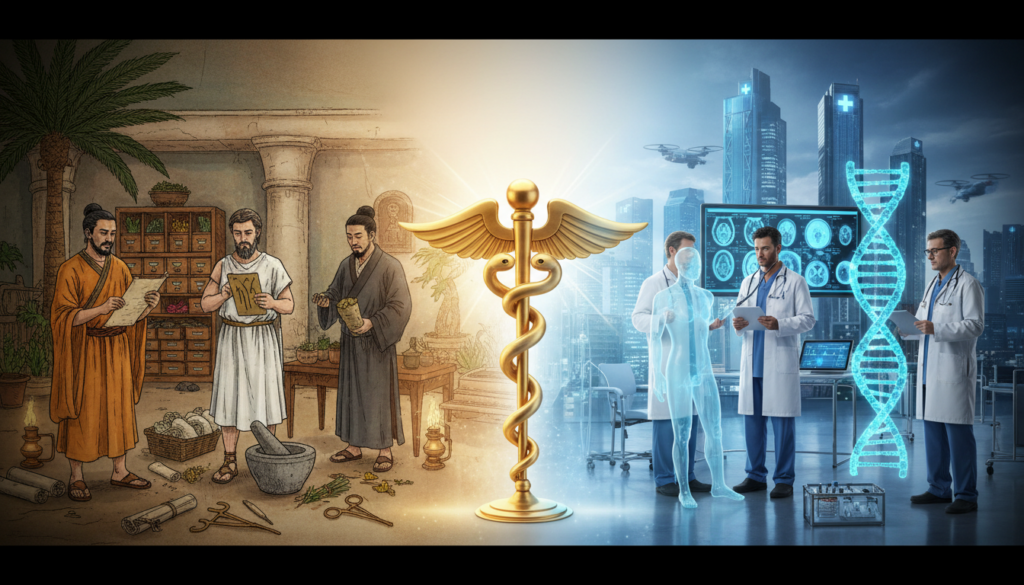
Looking across civilizations, traditional medical systems—such as Ayurveda in India, Traditional Chinese Medicine (TCM) in China, Unani in the Arab–Persian–South Asian world, and various indigenous systems in Africa and the Americas—are closer in spirit to what we now call “pathies.” They are holistic frameworks with their own theories of vital forces, humors, elements, meridians, or doshas, and their own pharmacopeias and procedures. Within each of these, there are numerous “therapies”: ayurvedic herbal therapy, TCM acupuncture therapy, moxibustion, cupping therapy, and so forth. This pattern—a large pathy containing many therapies—is found throughout medical history and across cultures.
In contemporary integrative medicine, clinicians often aim to combine evidence-based elements of different therapies while sometimes setting aside the more rigid, doctrinal aspects of any single pathy. For example, a cancer patient may receive conventional allopathic treatments (surgery, chemotherapy, radiotherapy) while also being offered supportive therapies such as nutritional therapy, exercise therapy, mindfulness-based stress reduction, or acupuncture for symptom control. The patient is not necessarily subscribing to acupuncture as a complete pathy; instead, specific therapies are being layered onto a biomedical foundation. This blending underscores how “therapy” functions as a toolbox, whereas “pathy” tends to denote a more comprehensive and sometimes exclusive framework.
In summary, the key difference is that “pathies” are whole medical systems or philosophies, often defined in contrast to one another, while “therapies” are individual treatment methods that can exist both inside and outside those systems. Pathies tell a broad story about what disease is and how health should be restored; therapies are the practical actions—drugs, procedures, exercises, dialogues, manipulations—used to move a patient from illness toward health. Understanding this distinction helps avoid confusion and allows patients and practitioners to make informed, nuanced choices, selecting therapies based on evidence and suitability, while being clear about whether they are embracing an entire medical worldview (a pathy) or simply using specific therapeutic tools.