
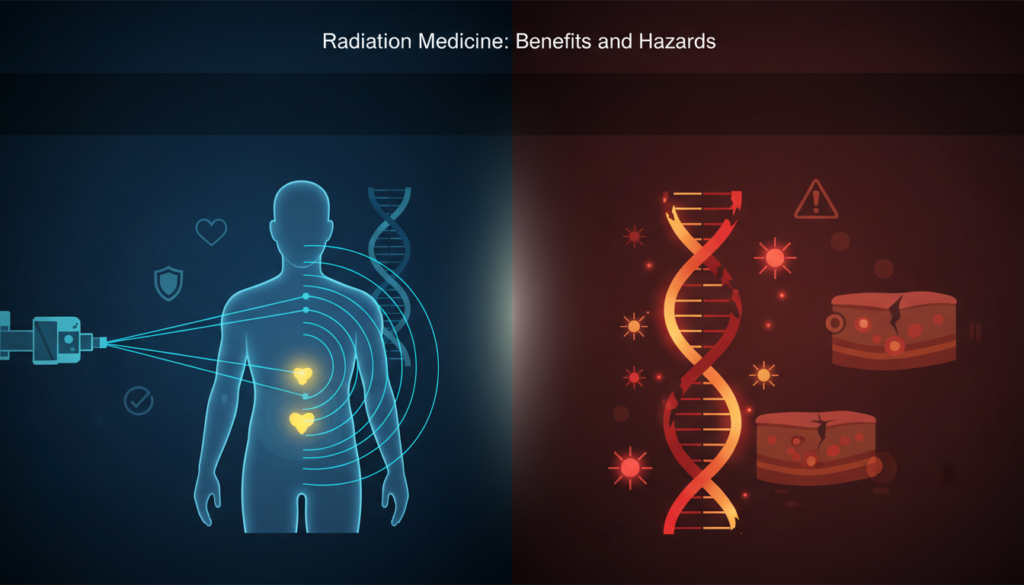
Radiation therapy, whether using photons, electrons, protons, or heavier ions, ultimately exerts much of its biological effect through interactions with water, the predominant component of human tissues. While DNA is the critical target whose damage correlates with cell kill, the majority of initial radiation energy deposition occurs in water molecules simply because they are so abundant. This fundamental fact underpins the central role of water as the universal solvent in modulating both the microphysical events of radiation interaction and the downstream biochemical cascades that define therapeutic efficacy and normal-tissue toxicity.
When ionizing radiation traverses tissue, it deposits energy in discrete tracks, producing ionizations and excitations. Given that human cells are ~70% water by mass and even higher by molecular count, most of these primary interactions involve H₂O rather than biomacromolecules. The radiolysis of water yields a suite of reactive species—most prominently the hydroxyl radical (•OH), hydrated electron (e⁻ₐq), hydrogen atom (•H), hydrogen peroxide (H₂O₂), and molecular hydrogen (H₂). Of these, •OH is the principal mediator of indirect DNA damage in conventional photon and electron radiotherapy. Thus, the “universal solvent” is not a passive medium; it is transformed into a chemically active, transient reaction field that bridges the physics of dose deposition and the biology of cell response.
The notion of “indirect action” in radiation biology is essentially the story of water-mediated damage. Direct action refers to ionizations occurring in DNA itself, whereas indirect action denotes radicals formed in water that subsequently diffuse and react with DNA, proteins, lipids, and other cellular constituents. For low linear energy transfer (LET) radiation such as megavoltage photons, roughly two-thirds of DNA double-strand breaks (DSBs) are thought to arise from indirect, water-radical–mediated processes. This fraction changes with LET: high-LET particles (e.g., α-particles, carbon ions) cause a greater proportion of direct DNA ionization and dense clustering of lesions, but even there, water’s radiolytic products contribute significantly to the local chemistry within the track core and penumbra.
At the nanometer to micrometer scale, the spatial distribution and temporal evolution of water radiolysis products are critically important. Tracks of radiation create highly localized spur and blob structures wherein radical concentrations are transiently extremely high. On the picosecond to microsecond timescale, these radicals diffuse, recombine, or react with solutes. The solvent properties of water—its dielectric constant, hydrogen-bond network, and ability to solvate ions and polar molecules—govern radical mobility and reaction rates. For instance, the lifetime and diffusion distance of •OH radicals, typically of the order of nanometers and nanoseconds, are dictated by their rapid reactivity in this aqueous milieu. Thus, water structure and microheterogeneity in the cytosol and nucleoplasm influence the probability that radicals actually reach and damage DNA.
Water as a solvent also defines the biochemical milieu in which radiation-induced oxidative stress is generated and regulated. The aqueous phase hosts not only free radicals but also antioxidants such as glutathione, ascorbate, and enzymatic scavengers (e.g., superoxide dismutase, catalase, peroxidases). The interplay among these species is governed by diffusion, solubility, and reaction kinetics in water. Radiotherapy-induced perturbations in the redox state of the cell—shifts in the GSH/GSSG ratio, accumulation of H₂O₂, or changes in mitochondrial ROS production—are all mediated in this solvent framework. In essence, water is the arena in which the cell’s defense systems meet the oxidative challenge posed by radiation-generated radicals.
The role of water extends further when we consider tissue oxygenation and the classical oxygen enhancement effect. Molecular oxygen, dissolved in tissue water, reacts with certain DNA radicals to “fix” the damage, converting transient, potentially reparable lesions into permanent ones. The solubility and diffusion of O₂ in the aqueous extracellular and intracellular spaces determine local partial pressure of oxygen (pO₂) at the microscale, which in turn dictates radiosensitivity. Hypoxic regions, characterized by lower dissolved oxygen in tissue water, are less radiosensitive to low-LET radiation because fewer DNA radicals are converted into irreversible lesions. Thus, water serves as the carrier and distributor of oxygen, making its solvent properties central to spatial heterogeneity in treatment response.
In the bloodstream and interstitial spaces, water also functions as a conduit for systemic and local responses to radiation. Cytokines, chemokines, and damage-associated molecular patterns (DAMPs) released from irradiated cells are transported through the aqueous phases of blood and lymph, orchestrating inflammatory and immune processes. The abscopal effect, in which localized radiation leads to responses in distant, non-irradiated sites, similarly depends on soluble mediators traversing through the vascular and interstitial water compartments. From this perspective, the universal solvent not only shapes primary chemical damage, but also participates in the relay of information that links local irradiation to systemic biological outcomes.
At the level of tissue microenvironment and vasculature, the physicochemical properties of water influence edema, perfusion, and nutrient delivery post-irradiation. Radiation-induced vascular injury can alter capillary permeability and hydrostatic–oncotic balance, leading to shifts in fluid compartments and interstitial water content. These changes can affect tissue oxygenation and drug delivery when radiation is combined with systemic therapies. Moreover, the aqueous extracellular matrix, rich in hydrated glycosaminoglycans and proteoglycans, can undergo structural and compositional changes secondary to radiation, modulating cell adhesion, migration, and fibrosis over time.
From a therapeutic modification standpoint, manipulating water-mediated chemistry is an important strategy in radiation oncology. Radiosensitizers and radioprotectors often work by altering radical chemistry in water. Electron-affinic compounds, for instance, can compete for hydrated electrons or DNA radicals, modulating fixable damage. Thiol-containing agents and other radical scavengers intercept •OH and related species in the aqueous compartment, preferentially protecting normal tissues. Similarly, hyperthermia, pH modulation, and agents that alter redox buffering all operate within the context of water-borne reactions, effectively rewiring the solvent-phase kinetics that link physical dose to biological effect.
Emerging modalities such as FLASH radiotherapy (ultra–high-dose-rate irradiation) and advanced particle therapies have reawakened interest in the dynamic behavior of water radiolysis at very high instantaneous doses. Under FLASH conditions, the concentration-time profiles of radicals and molecular products in water may differ significantly from conventional dose rates, potentially altering oxygen consumption, H₂O₂ accumulation, and other aqueous-phase processes in ways that preferentially spare normal tissues. Similarly, the radial dose distribution and track structure for protons and heavier ions define distinct microenvironments of water radiolysis, affecting relative biological effectiveness (RBE). These frontiers underscore that understanding water’s role is not merely academic; it is central to rational optimization of novel treatment paradigms.
In summary, water as the universal solvent in the human body is not a passive backdrop for radiation therapy; it is an active participant at every stage of the radiotherapeutic process. It mediates the conversion of physical energy deposition into chemical species, shapes the diffusion and interaction of radicals and oxygen, governs redox and signaling networks, and participates in vascular and microenvironmental responses. A refined understanding of water’s structural, kinetic, and transport properties in vivo—down to the nanoscopic and ultrafast domains—is essential for advancing radiobiological modeling and for designing interventions that selectively modulate solvent-phase chemistry. Ultimately, exploiting the central role of water offers a powerful avenue to enhance tumor control while minimizing normal-tissue injury in radiation therapy.